Our Family / Meghan’s ancestors / A historical chapter
Between two worlds.
Six generations of people lived very different lives before their histories became one family. In the Ontario townships, a name might survive beside a farmer’s occupation or a marriage witnessed in a local register. In Philadelphia, another name might be recorded beside a factory trade, a parish, or a street address. Neither record captures a whole life. Together, they give us places to begin.
History happened around them. Life happened to them.
These ancestors were never simply farmers, immigrants, soldiers, wives or workers. They were individuals making choices in specific places, although surviving paperwork rarely reveals what they wanted or felt.
The two landscapes below are not a claim that every branch followed the same path. They are a way to see how changing economies, neighborhoods and institutions formed the backdrop to particular documented lives.
01 / Canada West and Ontario
The townships. The households.
The Hilliard, Bartlett, Mitchell, Westcott and Ayre histories touch Etobicoke, Vaughan, King, Port Dover and Thorah. Some of the older household identifications remain provisional; others are connected by registrations naming parents.
1861 · A marriage, two earlier families
David Mitchell and Caroline Westcott
An Ontario marriage record names David’s parents as George Mitchell and Betsy Martin, and Caroline’s as George Westcott and a mother now read provisionally as Tamson Read (recorded as Tamzon in the inherited tree). It gives us names one generation farther back, but not their occupations or a verified account of how each family arrived in Ontario.
In May 1835, George Westcoatt and Thamsen Reed married at St Cuthbert’s in Wells, Somerset. Henry Westcott was baptized there that November, with parents George and Tamzen and his father described as a labourer of Burcott Lane. A strongly matching George and Tamzon household later appears in Thorah, Canada West. In the 1851/52 census, Charlotte was reported born in England and Caroline in Canada, suggesting a crossing around 1839–1843. The English–Canadian identification is probable, not conclusively proved; neither a passenger list nor an exact migration date has been established.
In Meare, Somerset, the parish register records James Read marrying Mary Milton on 1 August 1787. Sixteen years later, a Tamson Reade was baptized there on 6 March 1803, daughter of James and Mary; on 22 September 1805, the same parental names appear at the baptism of Caroline Reade. That Tamson is our preferred match for George Westcott’s future wife, and Mary Milton our preferred identification for her mother.
The earlier Read generation in Meare
An earlier Meare baptism, dated 3 December 1759, names John and Sarah Read as the parents of a child James. We now show that couple as a provisional earlier generation: their baptized son is our leading candidate for the James who married Mary Milton in 1787, but the connection between those records is not proved. Another original baptism dated 24 January 1762 names Stephen, son of John and Sarah Read; another child on that page belongs to John and Agnes Patch, a couple married at Meare in 1760, supporting a Meare identification for the register. An April 1751 marriage of John Read and Sarah Hemert or Hement is a promising lead, but its original register is identified as Lullington while modern indexes say Luxborough. Sarah’s earlier surname therefore remains a working possibility, not a settled fact. The 1829 Meare burial of a James Read aged 71 is likewise a candidate, not an established death. There is a small family echo across the Atlantic: Tamson’s own daughter in Ontario was also named Caroline.
In the digitized text of an 1869–70 Ontario County directory, a George Westcott appears against the south half of Concession 4, Lot 4, Thorah. When Tamson Westcott died in 1895, her informant Colin Campbell—identified as her son-in-law—gave Lot 4, Concession 4 as his address. The overlap suggests a useful land-record search, not a proven transfer or ancestral house. The directory also names James Cameron against the same south-half lot, so ownership and occupancy remain unresolved.
In County Fermanagh, Thomas Brock and Margery Breen appear in a reported 1753 marriage bond. A lease and later churchwarden records give Thomas a place in the parish of Inishmacsaint; descendant histories connect their son Francis with the Brock family later in York Township. These are preferred family ties, not an uninterrupted register of every generation.
A young Lucinda Brock appears with James and Sarah in an 1851 census; decades later, three separate marriage returns record Harris or Horace Bartlett and Lucinda Brock as parents. That repeated identification is more secure than the older Brock household's inferred relationships, which remain our preferred reconstruction. Through daughter Sarah Elizabeth’s 1886 marriage to James Hilliard, the families meet on the page.
Catherine was baptized in Durham, England, in 1893, with parents Thomas and Isabella named in the register. A child closely matching her details appears in a 1904 Barnardo group crossing to Canada. By 1913 she was marrying Levi Hilliard in King Township. The likely journey matters; so does the much longer adult life that followed it.
Walter Mitchell enlisted with Canada’s 182nd Battalion in 1916 after earlier service in the Royal Berkshire Regiment, now corroborated by original British military records. He reached sergeant before an over-age discharge in 1917, prior to his Canadian unit sailing overseas. In 1931, Walter was recorded as a general labourer and Levi Hilliard as a carpenter in a planing mill. These are details of work, not portraits of personality.
For the Conlin, Wurst, McDermott and Curran branches, occupation and address are often our closest approach to everyday life. A few records also suggest earlier connections to Ireland and Germany; some specific parent-child identities are still under review.
Late 1800s–1919 · Trade and family
Police work, machining, and a new household
John Joseph Conlin was recorded as a policeman. His son Francis appears in the instrument trade as a machinist. A 1919 Philadelphia church register records Francis or Frank Conlin’s marriage to Mamie Wurst. The earlier Boston-to-Camden Conlin trail remains an identity hypothesis, separate from this Philadelphia family.
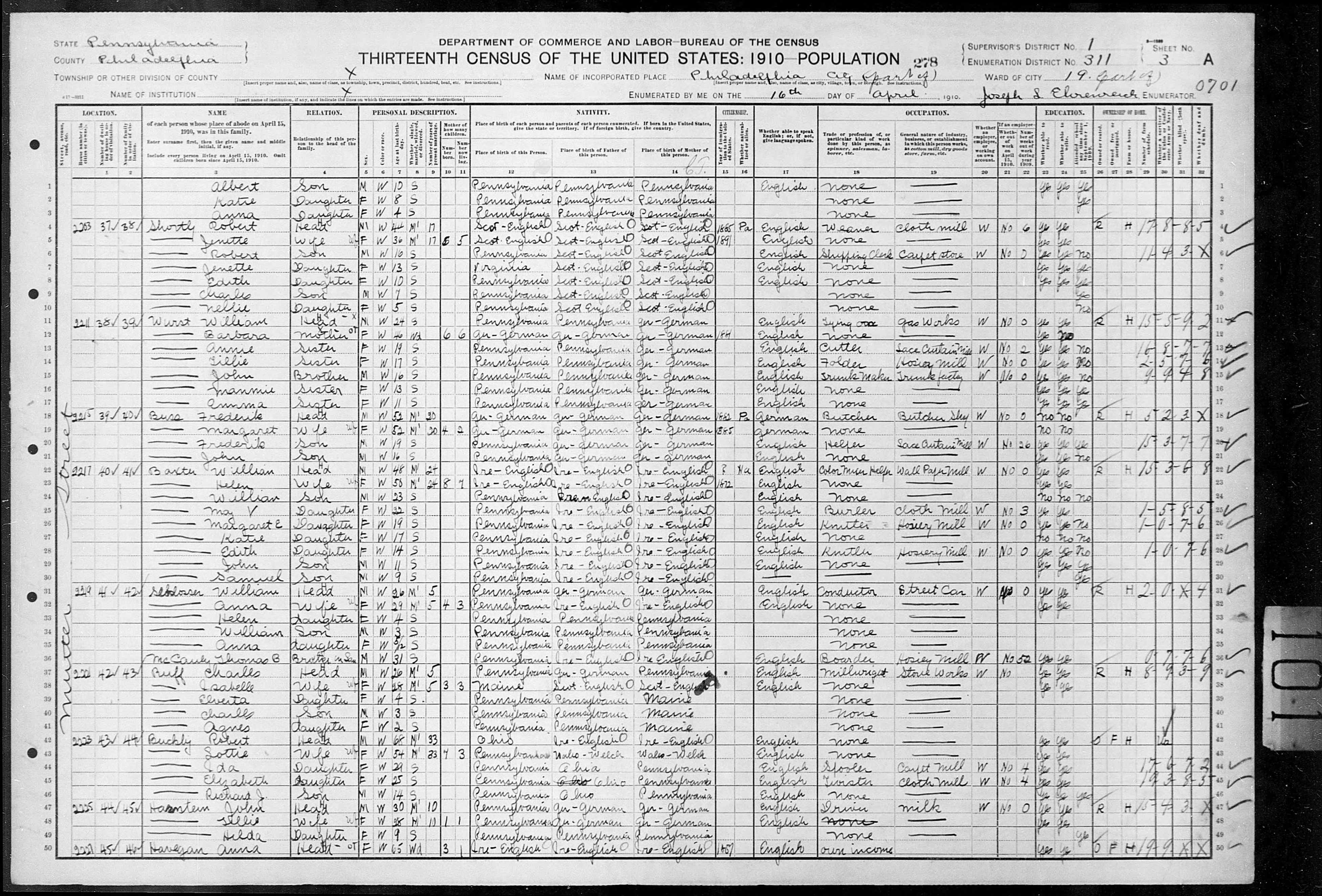
In 1910, Mamie Wurst lived with her widowed mother Barbara and her siblings. William, her twenty-four-year-old brother, worked at a gas works; Annie cut material in a lace-curtain mill, Tillie folded textiles, and John made trunks. In another household, young Elizabeth Curran was a shirtwaist operator. The women’s paid work belongs alongside the men’s in this family history.
In 1942 Frank Conlin worked for Link-Belt and named his mother as the person who would always know his location. Regina McDermott’s 1943 yearbook preserved her address and parish. By the 1950 census, Frank and Regina appeared together in a Philadelphia household. Their earlier records identify separate lives before they shared a home.
Regina’s obituary recalls thirty-one years at Muhlenberg College, beginning in the Registrar’s Office and later supporting a dean. The college had begun admitting women as full-time students in 1957, before her approximately 1962 start. She retired in 1993; the exact hiring date remains unconfirmed.
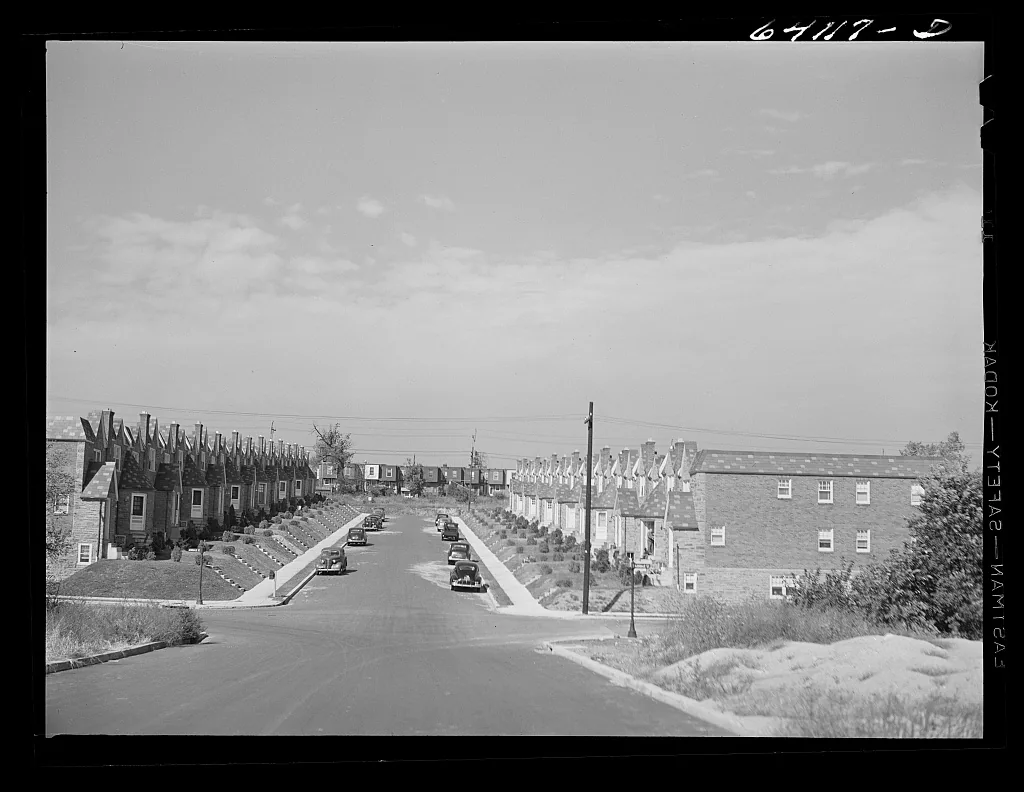
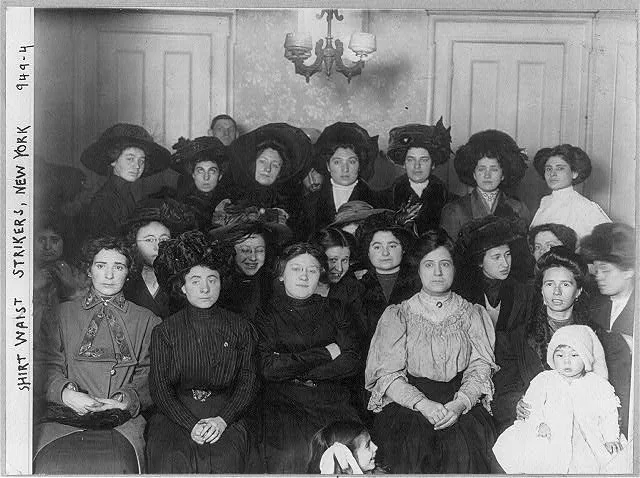
A city of households · Philadelphia · 1941A documented Philadelphia streetscape, not a verified photograph of a Conlin, Wurst, Curran, or McDermott home. Its precise block is not identified in the catalog. Library of Congress source ↗Organized women workers · New York · January 1910The photograph shows a strike meeting in New York, not Philadelphia. It offers contemporary context for the garment trade recorded in the Curran and Wurst households, without establishing any family participation. Library of Congress source ↗
03 / The people inside the records
Eight earlier lives. Eight distinct beginnings.
Beyond the familiar grandparents are people who rarely left a photograph or a letter we can read. A marriage entry, a daughter’s death certificate, or a census occupation can still restore a little of their individuality. These are portraits in words, drawn from specific records—not invented scenes.
From the Ontario branchesTownships and family ties
01 1886 · Port Dover to King
Sarah Elizabeth Bartlett
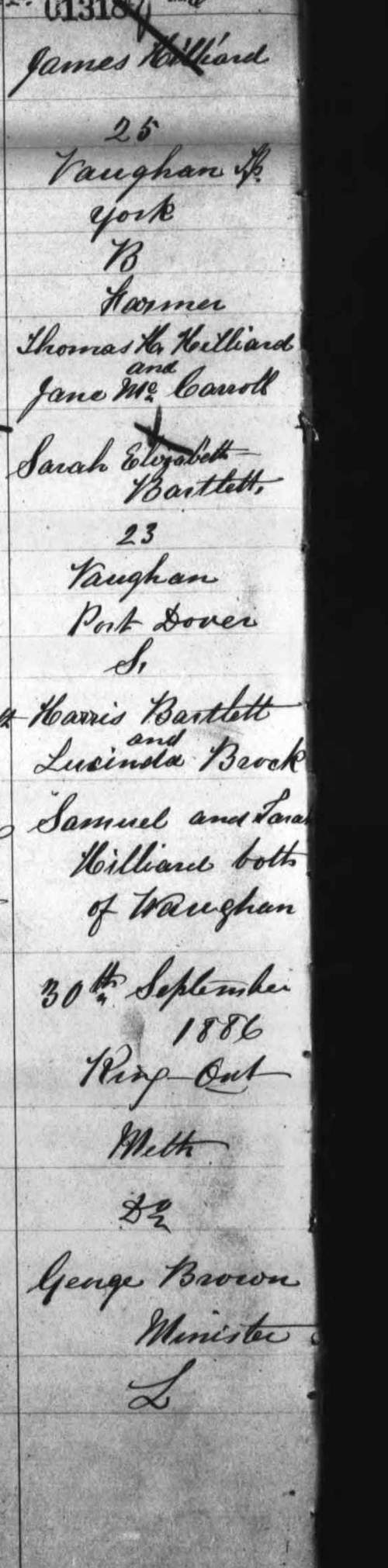
At her wedding in King Township in September 1886, Sarah was recorded as twenty-three and born in Port Dover. Her parents were named as Harris Bartlett and Lucinda Brock. Those details let us see that she brought a separate Ontario family history into her marriage to James Hilliard; she was more than a name added to the Hilliard line.
From the register · 30 September 1886. The original column names Sarah’s parents and records James’s work as a farmer. Cropped to this couple; the complete page remains in the private research archive. Read the source context ↗
The 1886 marriage register calls James a farmer, aged twenty-five, born in York County. Five years later, Levi’s birth record still describes his father’s occupation as farmer. Two records, written at moments of family change, leave the outline of a man’s working life. They do not reveal the size of his holding or the success of his harvests.
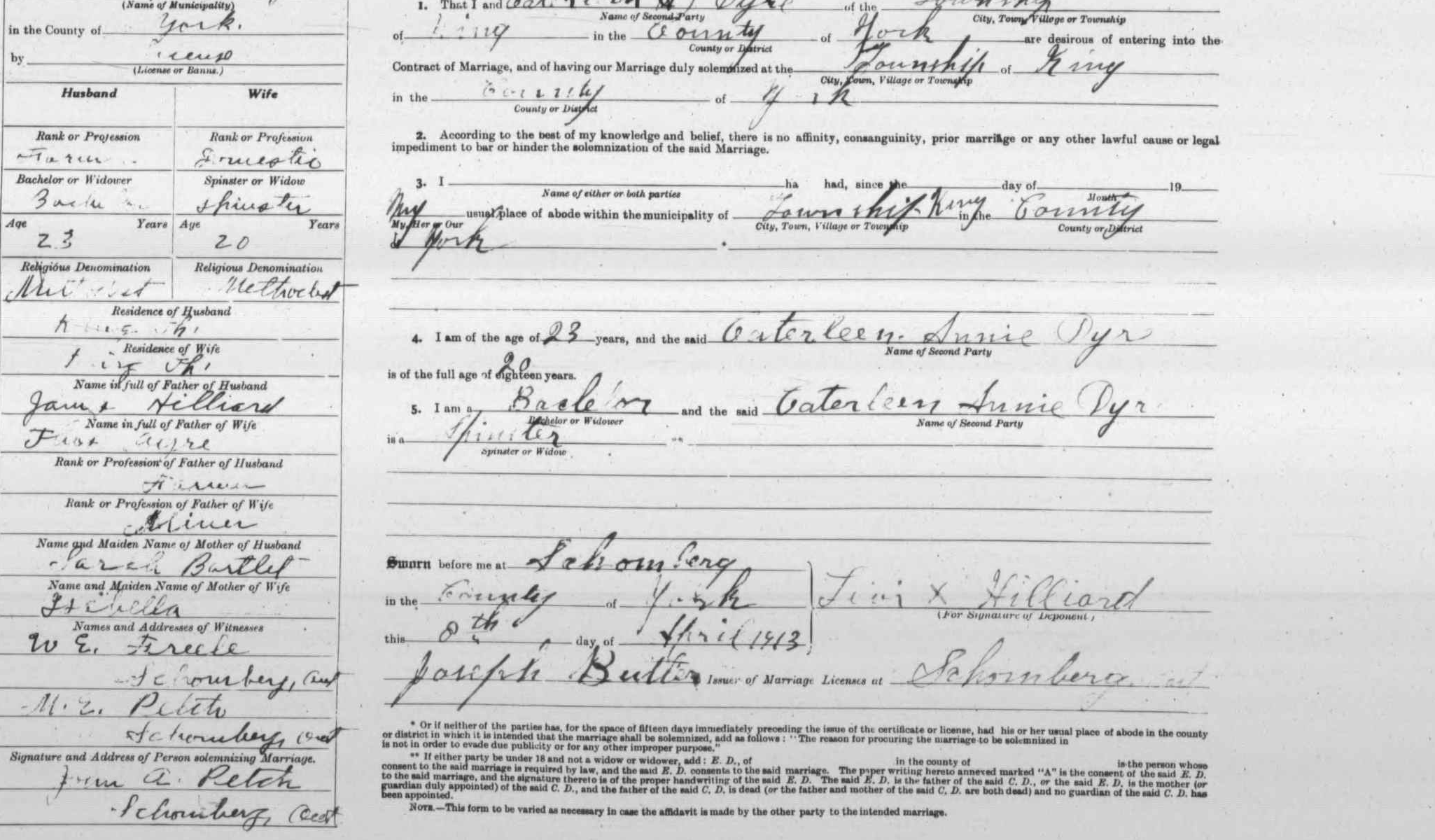
The following generation, 1913. James and Sarah’s son Levi married Catherine Ayre in King Township. This later record connects the family story forward; it is not an image of James’s marriage or farm. Read the full record context ↗
Caroline’s marriage to David Mitchell in November 1861 preserved a bridge to an earlier generation: her parents were recorded as George Westcott and a mother whose name appears to read Tamson Read. Our earlier transcription as Hannah was likely mistaken; the inherited family tree spells her name Tamzon. Decades later, a daughter’s 1946 death registration names Caroline again. The handwriting deserves another comparison before either spelling becomes definitive.
One line, two families · 27 November 1861. The entry appears to spell Caroline’s mother’s name Tamson rather than Hannah; David’s age also needs a second reading. This is a faithful excerpt of the original handwritten row. Read the Mitchell context ↗
The same 1861 marriage records David’s parents as George Mitchell and Betsy Martin. Its age entry appears to read 32, although earlier notes said 22; that discrepancy complicates a proposed identification with a boy in the 1851 Berkshire census. Emily Louisa Mitchell’s death registration, written many years later, reports David as her father. The specific English family identity remains unproved.
From the Philadelphia branchesWork and city households
05 1912 · A working trade
Thomas F. McDermott
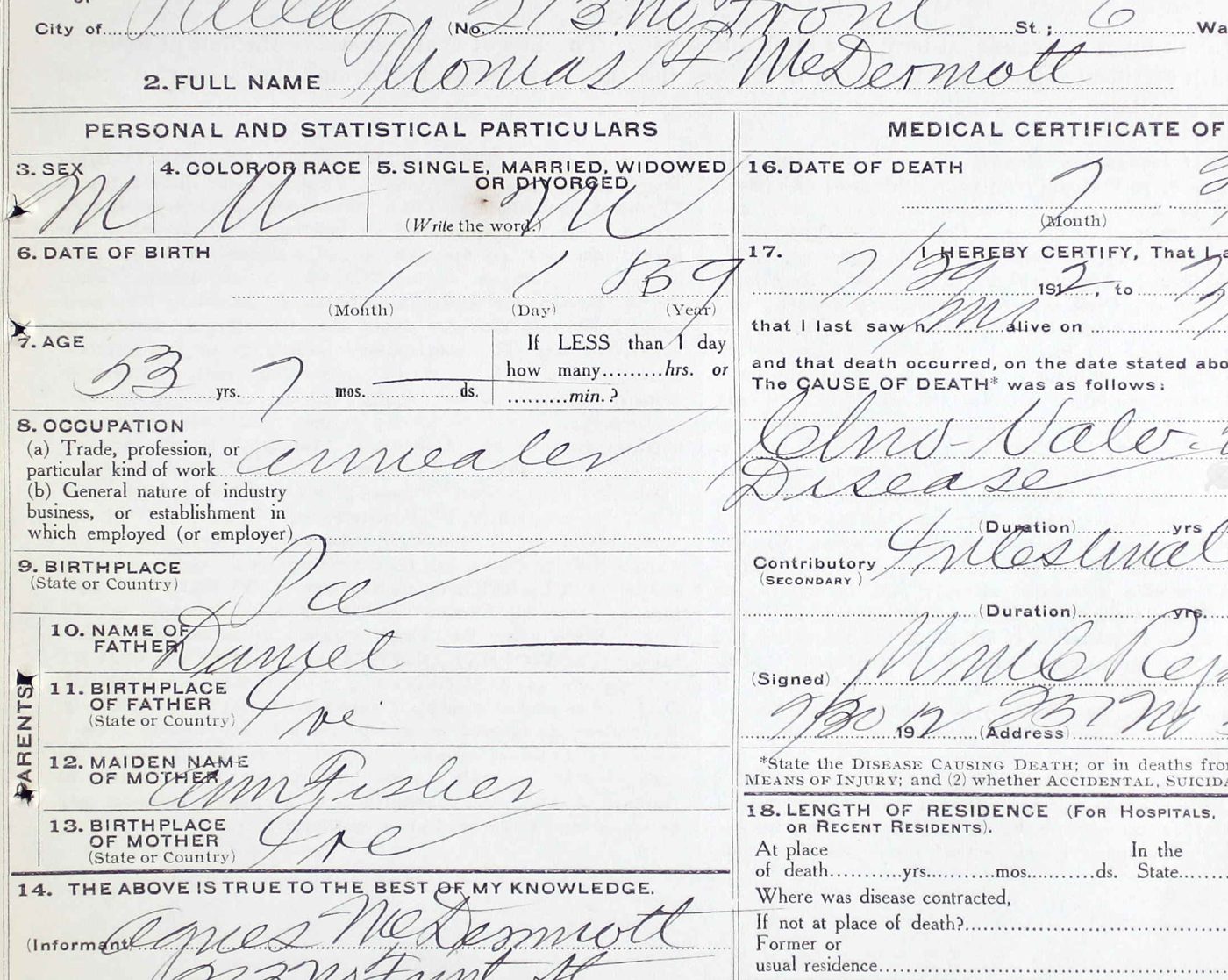
When Thomas died in Philadelphia in 1912, the death certificate recorded his trade as an annealer—work involving the heating and treatment of metal. It named his parents as Daniel McDermott and Ann Fisher, both reported born in Ireland. Those parental details were supplied by an informant, not by Thomas himself. The occupation places him in the city's manufacturing history, without telling us which workshop employed him or proving a connection to other similarly named McDermott families. An Agnes McDermott supplied the information, giving a North Front Street address. The certificate does not specify her relationship to Thomas or a maiden surname, but it leaves the name of another person alongside his own.
A working life named · 1912. Thomas's own certificate reports his metalworking trade and the names and origins of his parents. It does not establish where he worked or independently verify earlier Irish ancestors. Read the family context ↗
In a 1910 Philadelphia census, Elizabeth appears as a young shirtwaist operator. That entry places her in the paid clothing trade before the later household in which we know her as Regina McDermott’s mother. The census gives no employer or working conditions, and there is no basis for placing her at a particular factory or historical disaster.
Mamie’s father William is named in her later death certificate and in those of her sisters. He is not the gas-works employee on the 1910 census shown below. That William was his twenty-four-year-old son, living with his widowed mother Barbara and siblings Annie, Tillie, John, Mamie and Emma.
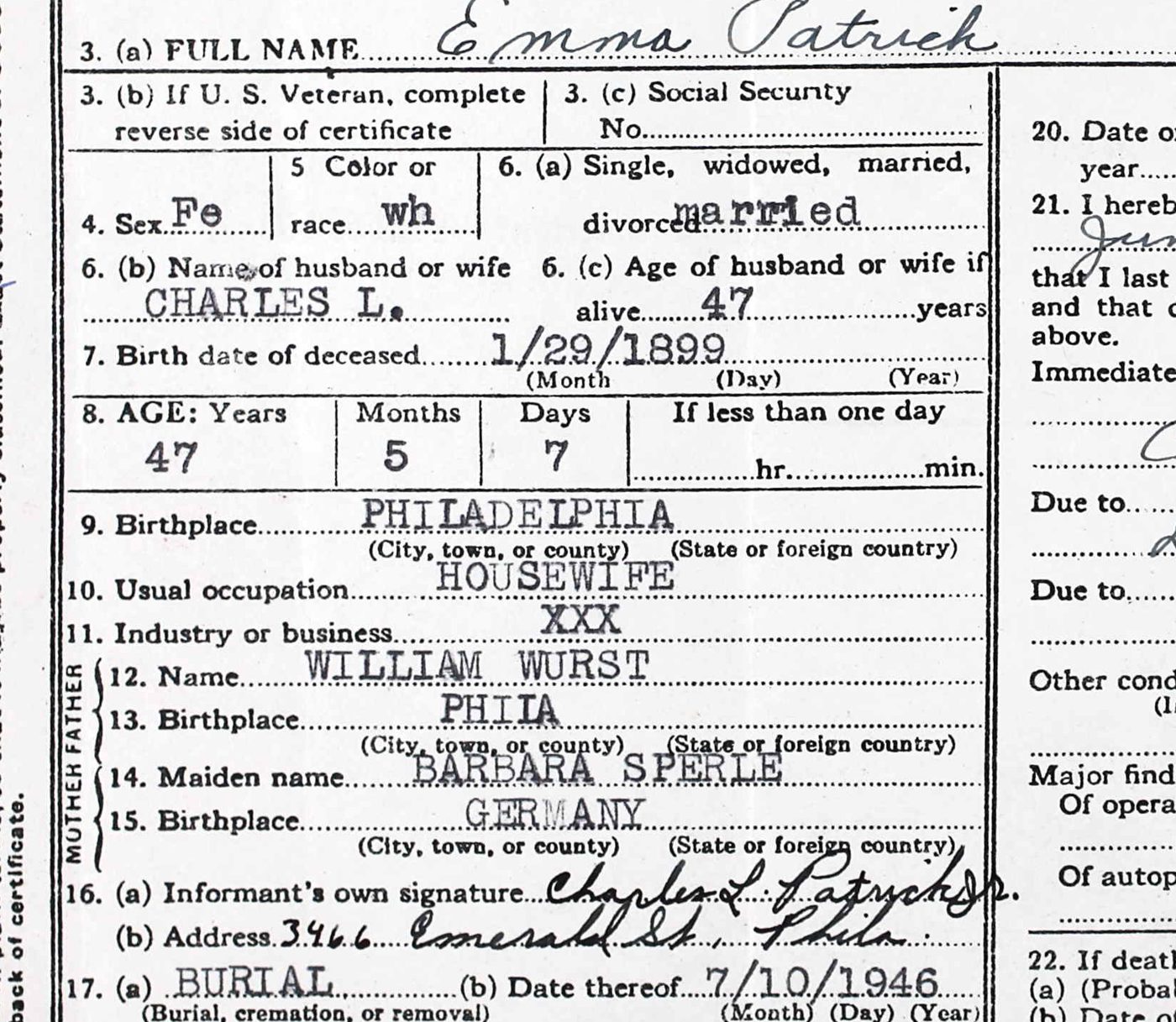
The father’s birthplace is reported as Philadelphia in Emma Patrick’s certificate and Germany in Anna Foell’s. His own parents remain unresolved; the imported Württemberg ancestry is held out of the published pedigree. The census gives us the younger household’s working lives, not the older William’s occupation.
Household and livelihood, 1910. The William listed here is Mamie’s brother, 24, not her father. Barbara is entered as his widowed mother; Annie, Tillie and John also have paid occupations. It is an original household record, not a photograph. See the Wurst family analysis ↗
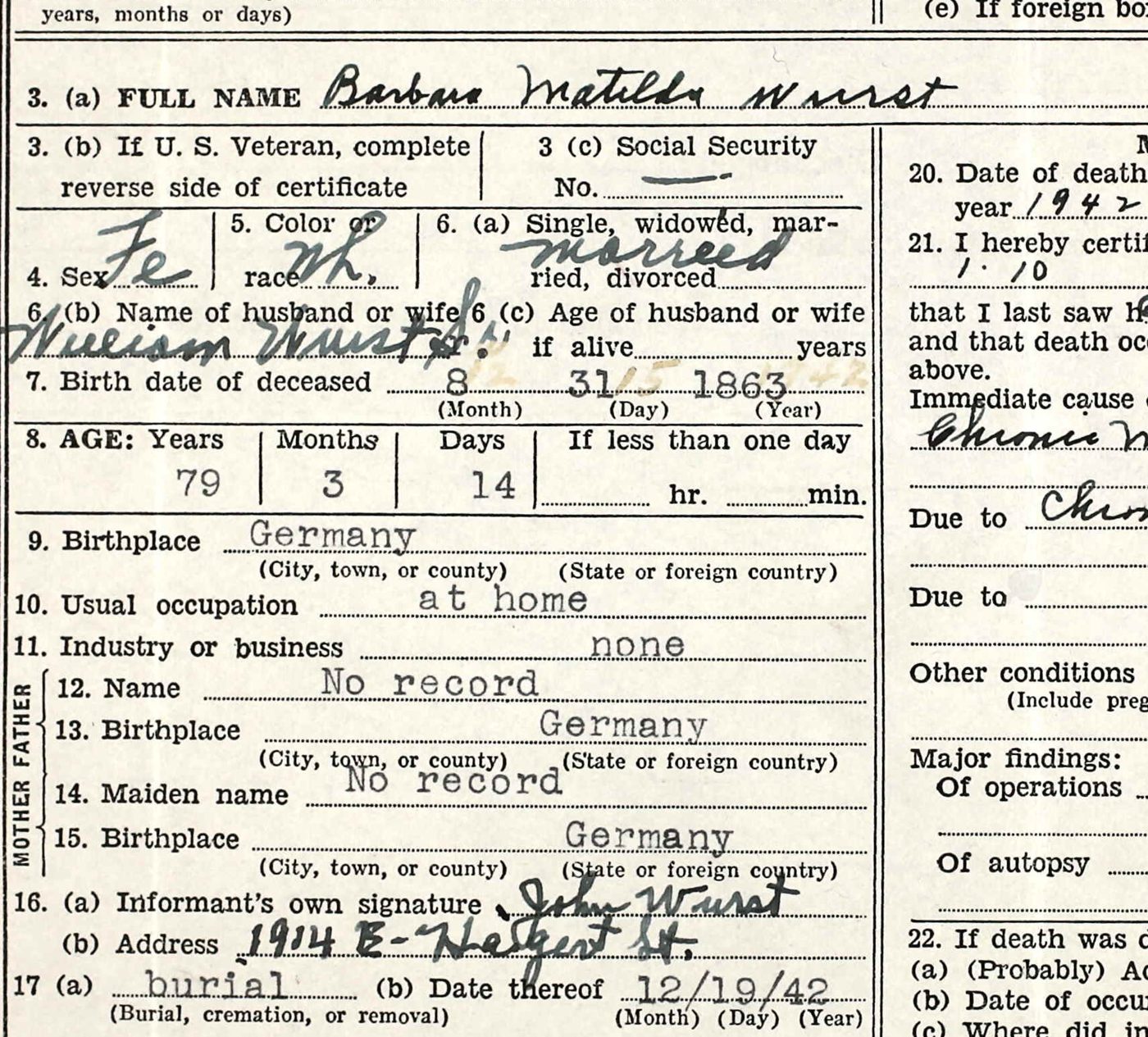
Barbara's 1942 Pennsylvania death certificate records her birth on 31 August 1863 in Germany, where it also places both of her parents—but their names are entered as “No record.” The form describes her occupation as “at home,” an official category that cannot capture everything she did in a household.
A second certificate, completed when her daughter Emma Patrick died in 1946, explicitly names William Wurst and Barbara Sperle as Emma's parents. That provides Barbara's reported maiden name independently of her own death record. Together the documents give her a clearer place in the Philadelphia family without identifying a German village, a voyage, or her parents.
A short funeral notice preserves a different detail. It calls Barbara the widow of William Wurst Sr., gives her former address as 2023 East Sergeant Street, and names St. Michael’s German Lutheran Church and Greenmount Cemetery. A Library of Congress building survey ↗ describes a German-speaking St. Michael’s congregation founded in 1871 at 2139 East Cumberland Street, in the same Kensington area. This is a promising identification of Barbara’s congregation, not yet confirmation from its membership register. The notice does not identify a hometown in Germany.
Two records, one family connection. Left: Barbara's 1942 death certificate establishes her reported German birth, not her maiden name. Right: her daughter Emma's 1946 certificate supplies Sperle. Both are informant-reported records, not photographs of either woman. Read the Wurst family context ↗
These portraits draw on the original records discussed in their linked family histories. A reported parent, occupation or birthplace is recorded as evidence from that particular document, not a guarantee that every older identity in the pedigree has been resolved.
04 / A family history still unfolding
Earlier generations. Unevenly visible.
Counting Meghan as the first generation, the private tree has names in all first five generations. The public tree protects living people and shows four grandparent branches through the sixth, where some ancestral identities remain unknown or disputed. The Read and Brock branches now continue into earlier generations.
4grandparents
8great-grandparents
16great-great-grandparents
20 / 32named sixth-generation positions
The sixth generation is a working pedigree, not 20 individually proven life histories. Some names come directly from marriage or death records; others are inherited candidates with dashed parent links. Twelve positions remain blank, including identities deliberately withheld when similar people could have been confused.
An occupation is not a personality. A birthplace is not an entire heritage. A marriage certificate cannot tell us how two people treated each other. And a possible family in an earlier census is not automatically the same family found decades later.
This account draws individual facts from the linked family biographies and their cited documents. The regional context comes from the institutions linked above. If a future photograph, letter or family memory changes the picture, the history should change with it. That is part of telling these lives fairly.